How to Compare Casting and Machining in 2026

Time:2026-09-24 Author:Oliver
0%

In 2026, manufacturers are asking a practical question: what is the difference between casting and machining, and which process delivers better value? The answer depends on geometry, material, production volume, tolerance, and the final service environment. A pump housing with internal passages may favor casting. A precision shaft may require machining from a solid billet.

Dr. John Campbell, a widely respected authority on casting metallurgy, stated, “The quality of a casting is determined by the quality of the liquid metal.” His observation remains highly relevant. Clean melt preparation, controlled filling, and careful solidification can reduce porosity and improve reliability. Machining offers a different advantage. It removes material with predictable accuracy, often achieving tight tolerances and smooth surfaces. Still, it can create significant waste, especially when most of a metal block becomes chips.

The comparison is not always clean. Casting can lower unit costs for complex shapes, but tooling investment and inspection requirements may be substantial. Machining is flexible for prototypes and small batches, although cycle time can rise quickly. In real workshops, engineers often combine both methods. A cast blank may receive final machining around bearing seats, sealing faces, and threaded holes.

This guide compares casting and machining for 2026 applications. It considers cost, speed, design freedom, dimensional accuracy, material performance, sustainability, and quality control. Some conclusions may change with better data. That is worth admitting. Production decisions should be tested through samples, process capability studies, and supplier discussions, not selected from attractive claims alone.
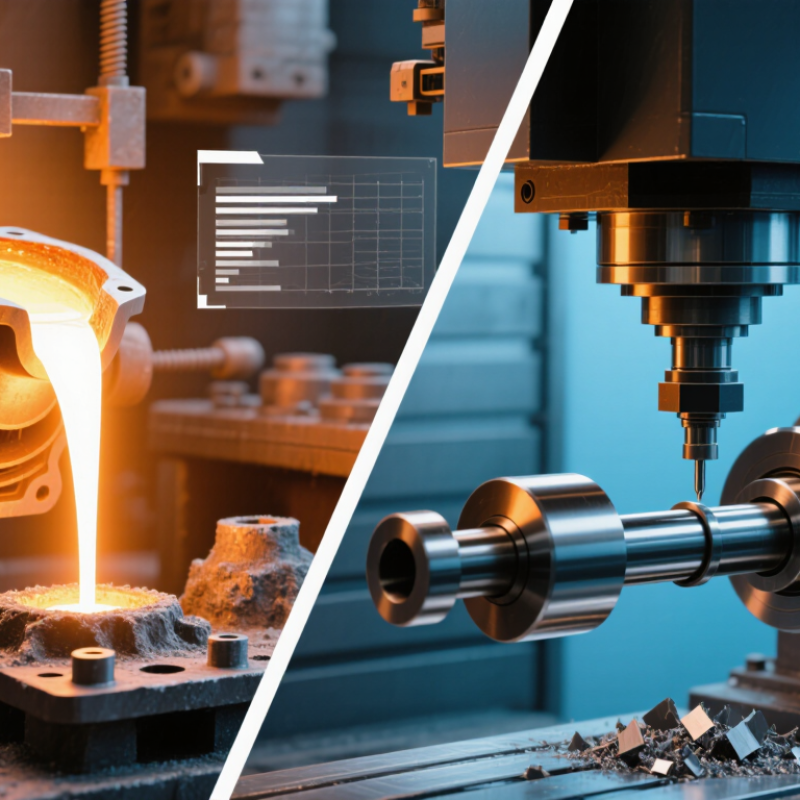
How to Compare Casting and Machining in 2026

Defining Casting and Machining in Modern Manufacturing

Casting and machining shape metal in different ways. Casting begins with liquid material poured into a prepared cavity. As it cools, the metal takes the cavity’s form. The mold may be made from sand, ceramic, or reusable metal, depending on the process and production needs. A cast housing can include ribs, curves, and internal passages that would be difficult to cut from solid stock.

Machining removes material from a solid workpiece using cutting tools. A lathe turns a part against a tool, while a milling machine moves a cutter across its surface. Drilling creates holes; grinding can refine dimensions and finish. The process follows a drawing or digital model, but tool access and clamping still affect what can be made. Small details matter. A few tenths of a millimeter can change whether two parts fit properly.

In practice, these definitions overlap at the part level. A casting may need machining on bearing seats, threaded holes, or sealing faces, where accurate contact matters. Conversely, a machined component may begin as a near-net-shape blank rather than a simple block. In 2026, digital inspection and process monitoring can help verify dimensions, but they do not remove the need for sound design and skilled setup. I have seen comparisons oversimplified: casting is not automatically cheaper, and machining is not always more precise in every feature. Material, geometry, volume, and required tolerances all shape the choice.

Comparing Their Materials, Processes, and Equipment

Casting and machining differ most in how they turn material into shape. casting pours molten metal into a mold, making complex cavities and near-net shapes in one operation. Sand casting handles large parts and varied alloys; die casting suits repeatable, thinner-walled components. Machining removes material with cutting tools, producing precise bores, faces, and threads. It can start from bar, plate, or a casting. That flexibility costs stock. Chips pile beneath the machine, and deep pockets may require several setups.

Material choice changes the equipment. Foundries need melting furnaces, molds, and temperature controls; machining shops rely on rigid machine tools, fixtures, and cutting tools. Aluminum illustrates a useful trade-off: the U.S. Geological Survey’s Mineral Commodity Summaries 2024 reports about 3.6 million metric tons of aluminum recovered from purchased scrap in 2023. Recycled feedstock can support either route, but alloy chemistry and cleanliness still matter. Casting tolerates intricate geometry, yet shrinkage and porosity require inspection. Machining delivers tighter local features, but tool access can limit design. A casting followed by finish machining is common. It is not automatically cheaper; mold cost, batch size, scrap, and cycle time decide. Small detail, big consequence. My own shop-floor judgment would still depend on the drawing and production volume.

Evaluating Accuracy, Surface Quality, and Design Flexibility

How to Compare Casting and Machining in 2026

Accuracy begins with the drawing, not the machine. ISO 8062-3:2023 classifies casting tolerances by dimensional range and process capability.

For a 100 mm cast feature, a typical CT7 allowance can approach 0.3 mm. That may suit a housing, but not a bearing seat.

Precision machining can often hold ±0.01 mm under stable conditions. Tool wear, thermal growth, and clamping still matter.

I have seen excellent machines produce poor parts after one unchecked setup change. Accuracy claims need inspection evidence.

±0.01 mm
Precision machining can often hold this tolerance under stable conditions.

Surface quality changes the comparison. Industry casting design guidance commonly lists sand-cast surfaces near Ra 12.5–25 µm. Investment casting can reach approximately Ra 3.2–6.3 µm. Machined surfaces often fall between Ra 0.8 and 3.2 µm, depending on tooling and feed rates.

Sand-cast surfaces
Ra 12.5–25 µm
Investment casting
Ra 3.2–6.3 µm
Machined surfaces
Ra 0.8–3.2 µm

ISO 21920-2:2021 defines how these roughness values should be assessed. A smoother surface is not automatically better. It can increase cycle time and remove useful material.

Casting also offers curved passages, ribs, and near-net shapes with fewer assembled parts. Machining offers sharper edges, tighter fits, and easier late-stage design changes.

The choice remains imperfect. Geometry, quantity, inspection cost, and material behavior must be judged together.

Industry production data from the 2023 World Casting Census also shows casting remains important at high volumes, where material efficiency can outweigh secondary finishing costs.

Analyzing Production Costs, Speed, and Scalability

In 2026, the cost gap between casting and machining depends less on the process label than on volume, geometry, and finishing needs. Casting requires patterns, tooling, and process development before parts flow; machining can start from stock with less dedicated tooling, but removes material one cut at a time. That difference matters. For a short run, a machined aluminum bracket may avoid pattern costs. At higher volumes, a casting can spread tooling costs across thousands of parts and reduce wasteful material removal.

Labor and capacity also shape the comparison. The U.S. Bureau of Labor Statistics reported a 2023 median annual wage of $51,000 for machinists and tool-and-die makers. That is not a per-part cost, but it underscores why machine time, setup, and skilled operation belong in any quote comparison. The American Foundry Society’s industry data describes a U.S. metalcasting sector with roughly 1,700 facilities, indicating broad production capacity, though local availability and alloy expertise still affect lead times. Check the actual supplier schedule.

Scalability is not automatic. Casting may scale well after tooling approval, but defects, yield, and secondary machining can erase expected savings. Machining scales through additional machine hours, shifts, or equipment; each route can bottleneck. Compare quoted cycle time, scrap assumptions, inspection, finishing, and delivery—not just unit price. One uncomfortable truth: early estimates often miss rework. Request a pilot batch and measure the finished parts before committing to a production forecast.

How to Compare Casting and Machining in 2026 – Analyzing Production Costs, Speed, and Scalability

Planning comparison: aluminum sand casting versus CNC machining from billet for a representative 1 kg part with moderate complexity. Figures are illustrative 2026 planning ranges in USD, not supplier quotations; actual results vary with geometry, alloy, location, inspection, finishing, and order terms.

Comparison dimension Aluminum sand casting CNC machining from billet Practical implication
Typical initial tooling and setup Pattern, tooling, and process setup: approximately $5,000–$25,000 Workholding, programming, and setup: approximately $1,000–$8,000 Machining generally requires less upfront investment for a new part.
Estimated unit cost at 100 parts Approximately $35–$80 per part, excluding one-time tooling Approximately $80–$180 per part Casting may already be cost-competitive if the part geometry suits the process.
Estimated unit cost at 1,000 parts Approximately $15–$35 per part, excluding one-time tooling Approximately $35–$80 per part Higher casting setup costs are spread over more parts, improving its unit economics.
Estimated unit cost at 10,000 parts Approximately $8–$20 per part, excluding one-time tooling Approximately $25–$60 per part Casting often has a cost advantage at sustained volume, subject to yield and finishing requirements.
First-part lead time Typically about 4–10 weeks, including tooling and sample approval Typically about 1–4 weeks, depending on programming, material availability, and queue Machining is often faster for prototypes and urgent low-volume orders.
Repeat production cycle Often several minutes per casting cycle; cooling, fettling, inspection, and finishing add time Often tens of minutes to several hours of machine time per part, depending on features and batch setup Casting can support higher output per tool; machining capacity depends heavily on machine hours and automation.
Typical achievable tolerance As-cast dimensions are generally less precise; critical surfaces commonly need machining A few hundredths of a millimeter may be achievable on suitable features with controlled conditions Specify tolerances feature by feature; tight tolerances can raise cost in either process.
Material utilization Near-net shape can reduce stock removal; runners and gates may be recycled where process controls allow Material is removed from billet; chips can often be recycled, but add handling and recovery steps Casting can use less starting material for bulky or complex shapes.
Geometry and design flexibility Can form ribs, bosses, and some internal cavities; draft, wall thickness, and core design matter Well suited to precise accessible features; deep cavities, thin walls, and complex tool access can be challenging Choose based on part geometry and functional features, not process cost alone.
Production scalability Strong fit for recurring medium-to-high volumes once tooling and process are stable Scales by adding machine capacity, shifts, or parallel suppliers; cost per part may remain higher Casting rewards stable demand; machining accommodates demand changes with less dedicated tooling.
Best-fit production scenario Complex near-net shapes, recurring batches, and volumes that can amortize tooling Prototypes, low-volume production, frequent design revisions, and tight-tolerance features A hybrid approach—casting the basic form and machining critical surfaces—can be effective.

Choosing Between Casting and Machining in 2026

Choosing between casting and machining in 2026 depends on part geometry, production volume, and how much variation your design can tolerate. Casting forms a component from molten material inside a mold. It can produce complex shapes and reduce material waste when many parts are needed. Machining removes material from a solid block, using tools to create precise surfaces and features. It is often practical for prototypes, small batches, and parts with tight dimensional requirements.

Look closely at the part itself. A thick housing with curved internal passages may suit casting, especially when the mold can form those features directly. A small shaft with a precise bearing seat may be easier to machine. Casting usually needs tooling and may require cleanup or inspection for porosity. Machining can deliver accurate dimensions, but deep pockets and heavy material removal may increase time and cost. Details matter.

Ask suppliers for process-specific estimates, not just a price per part. Compare tooling, setup, finishing, inspection, and expected scrap. Request samples, then check critical dimensions and surface quality under realistic conditions. A hybrid approach can also work: cast a near-net shape, then machine only the mating faces. There is no universal winner. Early estimates can be misleading, and I would revisit them after the design and annual volume become clearer.

How to Compare Casting and Machining in 2026

Typical dimensional tolerance capability by process. Lower values indicate tighter control. Actual results vary with alloy, part size, geometry, equipment, and inspection requirements.

Decision guide: Casting is generally more suitable for complex shapes and higher production volumes, while CNC machining is typically preferred for tight tolerances, low-to-medium volumes, and late design changes. Investment casting can achieve tighter tolerances than sand casting, but usually requires more specialized tooling and process control.

FAQS

What is casting in modern manufacturing?

Casting pours molten metal into a prepared mold. As it cools, the metal takes the mold’s shape.

What does machining do?

Machining removes material from a solid workpiece. Lathes, milling machines, drills, and grinders create controlled features.

Which process handles complex shapes better?

Casting can form ribs, curves, and internal passages directly. These features may be difficult to cut from solid material.

Is machining always more precise than casting?

No. Machining often produces accurate surfaces and tight dimensions. Casting can also work well when the mold and process are controlled.

Which method suits prototypes and small batches?

Machining is often practical for prototypes and small production runs. It avoids some tooling costs and supports design changes.

When is casting a better choice?

Casting may suit thick housings, curved passages, and larger quantities. It can reduce material waste with near-net shapes.

Do cast parts usually need machining?

Often, yes. Bearing seats, threaded holes, and sealing faces may need machining. Those surfaces require reliable contact and accurate dimensions.

What costs should buyers compare?

Compare tooling, setup, finishing, inspection, scrap, and part prices. A low unit price can hide expensive tooling.

Can casting and machining be combined?

Yes. A near-net casting can be machined only on mating faces. This hybrid method may save time and material.

What should be checked before choosing a process?

Review geometry, annual volume, material, tolerances, and tool access. Request samples and measure critical features under realistic conditions. Early estimates can mislead.

Conclusion

This article explains how casting and machining serve different roles in modern manufacturing. Casting forms a component by pouring or injecting molten material into a mold, while machining removes material from a solid workpiece using cutting tools. It compares the materials, processes, and equipment used for each method, then considers how their strengths affect accuracy, surface quality, and design flexibility. The question “what is the difference between casting and machining” depends not only on how parts are made, but also on the requirements of the finished product.

The article also examines production costs, lead times, and scalability. Casting can be effective for complex shapes and larger production runs, while machining offers precise control and flexibility, especially for simpler quantities or tightly specified features. By weighing part geometry, material, quality targets, volume, and schedule, manufacturers can choose the approach—or combination of approaches—that best fits their needs in 2026.

Oliver

Oliver

Oliver is a seasoned marketing professional with a wealth of expertise in driving brand awareness and engagement. With a deep understanding of our company's product offerings, he consistently delivers high-quality content that enriches our professional blog. His insights not only shed light on......