How to Choose the Best Material for High Temperature Applications?

Time:2026-10-19 Author:Aria
0%

Choosing a material for extreme heat is not a simple search for the highest melting point. Real equipment faces oxidation, creep, thermal shock, pressure, vibration, and repeated heating cycles. A furnace liner may glow orange, while its surface slowly cracks after hundreds of cycles. The right choice must survive the entire operating environment.

So, what is the best material for high temperature applications? The answer depends on temperature, atmosphere, loading time, manufacturing limits, and maintenance conditions. Nickel-based superalloys often perform well in hot, stressed components. Ceramic materials tolerate higher temperatures but may fracture under sudden impact. Refractory metals offer exceptional heat resistance, yet oxidation can become a serious weakness. Even stainless steel may be suitable when temperatures remain moderate and costs matter.

Materials selection expert Professor Michael F. Ashby offers a practical principle: “The best material is the one that meets the design requirements most economically.” This idea remains useful for engineers comparing alloys, ceramics, composites, and protective coatings. It also demands honest testing. Laboratory data may not reflect dust, moisture, uneven heating, or careless installation.

There is no universal winner.

A reliable decision combines property data, service experience, supplier documentation, and application-specific testing. Engineers should examine creep curves, oxidation rates, thermal expansion, weldability, and failure records. A material that looks excellent on paper may disappoint in a furnace door or turbine section. Careful selection reduces downtime, improves safety, and prevents expensive replacement after only a few operating cycles.
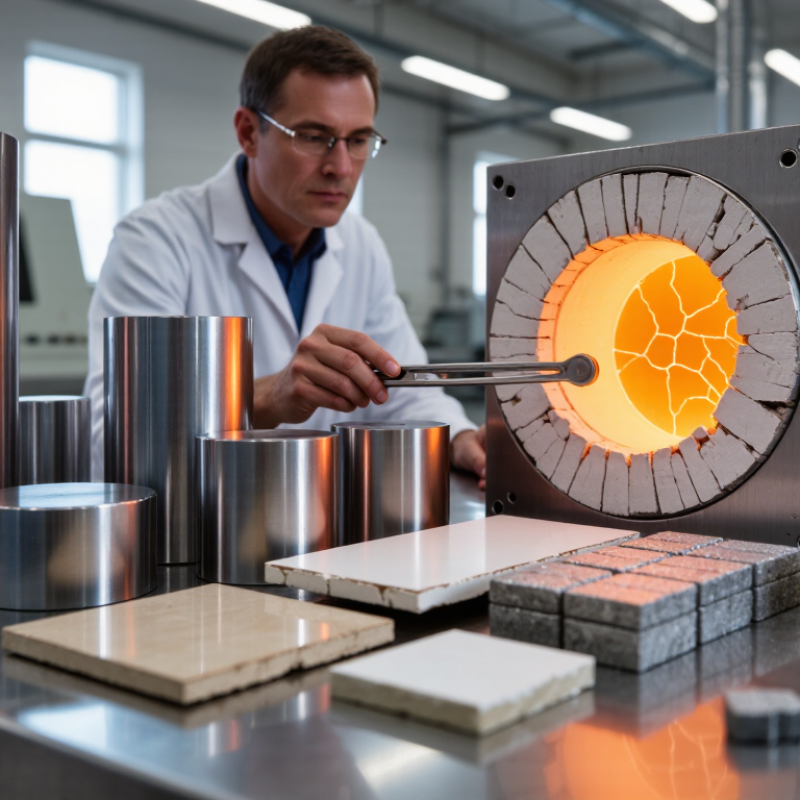
How to Choose the Best Material for High Temperature Applications?

Define the Service Temperature: 500°C, 1000°C, or Above 1600°C

How to Choose the Best Material for High Temperature Applications?

Define the Service Temperature: 500°C, 1000°C, or Above 1600°C

At 500°C, many stainless steels remain practical, but strength declines with time.

Creep matters more than the thermometer reading. ASM International’s ASM Handbook explains that prolonged heat can cause grain growth, oxidation, and dimensional distortion. In field inspections, thin sections often fail first near welds, bends, and fasteners. A polished surface can look healthy while internal creep has already started.

At 1000°C, material selection becomes less forgiving.

Nickel-based alloys may retain useful strength, depending on atmosphere, stress, and exposure time. The U.S. Department of Energy’s Industrial Decarbonization Roadmap identifies high-temperature process heat as a major engineering challenge. This supports a practical rule: check the full thermal cycle, not only the peak temperature. Rapid heating and cooling can create cracks. Sometimes, the “best” alloy performs poorly because the furnace atmosphere was ignored.

Above 1600°C, ceramics, refractory metals, and engineered refractories usually enter the discussion.

The National Institute of Standards and Technology provides high-temperature thermophysical data showing that thermal expansion and conductivity vary sharply among material classes. Yet laboratory data may not match production conditions. Dust, vibration, oxygen, and uneven loading can change the result. Request creep, oxidation, thermal-shock, and compatibility data before approval. A temperature rating alone is not enough.

Compare Maximum Use Temperatures: Nickel Alloys Near 1100°C and SiC Near 1600°C

Choosing a material for high-temperature service starts with the real operating temperature, not the furnace setting. A chamber may display 1100°C, while supports experience less heat. Local hot spots can still exceed the reading.

Nickel alloys commonly offer maximum use temperatures near 1100°C. They combine useful strength, toughness, and oxidation resistance. These properties suit heated fixtures, fasteners, and load-bearing components. Performance depends on stress, atmosphere, exposure time, and thermal cycling.

Silicon carbide, or SiC can operate near 1600°C in suitable conditions. That wider margin is valuable in very hot furnace zones. SiC also resists creep and retains stiffness better at extreme temperatures. It is not indestructible. Its brittleness makes impacts, sharp corners, and uneven heating serious concerns. Joining and machining require careful engineering.

The simple comparison is useful, but incomplete. A technician should measure temperatures at the component surface and review load conditions. Small thermocouples can reveal gradients that a controller misses. Test coupons may expose coating loss, distortion, or cracking before production begins. Temperature ratings are often treated as guarantees. That is a risky assumption. Material selection may need revision after one thermal cycle. Check heating and cooling rates. Also inspect the support design, because poor contact can create concentrated stress.

Evaluate Oxidation Resistance Through 1000-Hour High-Temperature Exposure

Choosing the best material for high-temperature applications requires more than checking its melting point. Oxidation resistance often determines service life. A 1000-hour high-temperature exposure test can reveal how a material behaves during prolonged operation.

In practical testing, prepare several identical coupons with measured surface areas. Record their initial mass, dimensions, and surface condition. Expose them at the intended temperature in air or a controlled atmosphere. Keep the temperature stable.

Small details matter. Monitor mass changes at regular intervals, such as 100, 500, and 1000 hours. A growing oxide layer may increase mass first, then begin to flake away.

After exposure, inspect each sample under magnification. Look for cracks, peeling scales, deep penetration, and color changes. Measure the oxide thickness across multiple locations. One attractive surface can hide uneven damage. We once treated low mass gain as proof of strong performance, but loose oxide had already detached from the sample. That assumption needed correction.

Compare oxidation rate, scale adhesion, dimensional stability, and mechanical condition together.

A material with moderate oxidation may still perform well if its protective layer remains tightly bonded. Test results should also include heating and cooling cycles, because thermal stress can damage an oxide film. Conditions in real equipment may differ from the laboratory. Record humidity, gas flow, temperature variation, and handling methods carefully. Reliable material selection comes from evidence, not appearance alone.

Match Thermal Shock Performance Using Alumina’s 8.9 × 10⁻⁶/K Expansion

How to Choose the Best Material for High Temperature Applications?

Match Thermal Shock Performance Using Alumina’s 8.9 × 10⁻⁶/K Expansion

Choosing a high-temperature material starts with more than its maximum service temperature. Thermal expansion deserves equal attention. Alumina with an expansion coefficient near 8.9 × 10⁻⁶/K can limit dimensional change during repeated heating and cooling. That stability helps reduce cracking where components face sharp temperature swings.

In practical furnace and kiln design, I compare alumina’s expansion with nearby metals, ceramics, seals, and supports. A mismatch can create stress at every cycle. Small mismatch, large stress. If a metal frame expands faster than an alumina insulator, the joint may loosen or fracture. Engineers should also examine thermal conductivity, flexural strength, wall thickness, and heating rate. Thermal shock performance never depends on expansion alone.

The 8.9 × 10⁻⁶/K figure is useful, but it is not universal. Alumina purity, test temperature, grain structure, and manufacturing quality can change the result. Always request data measured across the expected operating range. A room-temperature value may not represent furnace conditions. That detail matters.

I have learned that simple material comparisons can hide installation problems. A dense alumina part may resist chemical attack yet fail after uneven heating. Rounded corners, controlled ramp rates, and proper support can improve service life. Still, design assumptions should be challenged before production. Not always. Testing a representative assembly under real thermal cycles often reveals stresses that datasheets cannot show.

Verify Creep Strength, Chemical Compatibility, Cost, and ASTM Test Data

How to Choose the Best Material for High Temperature Applications?

Choosing a material for high-temperature service requires more than reading its maximum temperature rating. Under sustained load, creep can occur while the surface still looks unchanged. Review creep-rupture data at the actual temperature, stress, and exposure time. Short laboratory tests may hide long-term deformation. That matters. Compare yield retention, dimensional stability, and expected service life. No material wins every test.

Chemical compatibility deserves equal attention. Hot gases, steam, salts, and process fluids can attack surfaces or weaken grain boundaries. Request data from tests using similar atmospheres, pressures, and thermal cycles. ASTM methods improve comparison, but they cannot replace application-specific validation. Check specimen orientation, test duration, and failure criteria. Small details can change conclusions. Cost should include machining, coatings, inspections, replacement, and downtime.

Tips: Build a comparison table with creep strength, chemical resistance, ASTM method, temperature range, and cost assumptions. Request traceable reports and material certificates. Test a representative sample under realistic conditions. Promising data can fail after repeated heating and cooling. A conservative safety margin is usually wise. When evidence is incomplete, record the uncertainty instead of guessing.

How to Choose the Best Material for High Temperature Applications?

Compare representative continuous-use temperature limits in oxidizing air before verifying creep strength, chemical compatibility, cost, and ASTM test data.

Creep Strength

Verify time-at-temperature performance with ASTM E139 and elevated-temperature tensile data from ASTM E21.

Chemical Compatibility

Check oxidation, carburization, sulfidation, and process-fluid exposure using application-specific corrosion testing such as ASTM G31.

Cost and Availability

Compare total lifecycle cost, machining, joining, replacement frequency, and supply availability rather than material price alone.

ASTM Test Data

Use traceable test reports that match the actual temperature, atmosphere, stress level, geometry, and expected service life.

The chart shows representative engineering screening values for continuous exposure in oxidizing air. Actual limits depend on grade, load, atmosphere, section size, thermal cycling, and design requirements.

FAQS

Which material handles higher temperatures?

Silicon carbide can operate near 1600°C in suitable conditions. Nickel alloys commonly suit temperatures near 1100°C. Ratings are not guarantees.

Why should actual component temperature be measured?

Furnace displays may miss surface gradients and local hot spots. Small thermocouples can reveal these differences. Measure where the load sits.

When are nickel alloys useful?

Nickel alloys provide strength, toughness, and oxidation resistance near 1100°C. They suit fixtures, fasteners, and load-bearing parts. Stress still matters.

What makes silicon carbide attractive?

Silicon carbide retains stiffness and resists creep at extreme temperatures. It offers a wider margin in very hot furnace zones. It remains brittle.

What can damage silicon carbide components?

Impacts, sharp corners, and uneven heating can cause cracking. Joining and machining need careful control. One careless contact may matter.

How should creep performance be evaluated?

Review creep-rupture data at the real temperature, stress, and exposure time. Short tests can hide long-term deformation. Surface appearance can mislead.

Why does the surrounding atmosphere matter?

Hot gases, steam, salts, and process fluids may attack surfaces or grain boundaries. Request tests using similar chemistry and pressure. Compatibility is easy to overestimate.

What costs should material selection include?

Include machining, coatings, inspections, replacement parts, and downtime. A cheaper material may create repeated maintenance. My estimate could still be incomplete.

How can a material choice be validated?

Test a representative sample through realistic heating and cooling cycles. Inspect for coating loss, distortion, and cracks. Revise the choice if evidence changes.

Conclusion

Choosing the right material for extreme heat begins with defining the service temperature: around 500°C, near 1000°C, or above 1600°C. The question “what is the best material for high temperature applications” cannot be answered by temperature alone. Nickel alloys may perform reliably close to 1100°C, while silicon carbide can remain suitable for temperatures approaching 1600°C. Material selection should also include a 1000-hour high-temperature exposure test to assess oxidation resistance and long-term stability.

Thermal shock performance is equally important, especially where heating and cooling are rapid. Alumina, with a thermal expansion coefficient of approximately 8.9 × 10⁻⁶/K, provides a useful reference when comparing dimensional stability. Engineers should further evaluate creep strength, chemical compatibility with the operating environment, total cost, and available ASTM test data. A balanced review of these factors helps ensure safe, durable, and economical performance in demanding high-temperature systems.

Aria

Aria

Aria is a dedicated marketing professional with a deep passion for innovative strategies and a keen understanding of our company's product offerings. With a wealth of experience in the industry, Aria excels at crafting engaging content that highlights the unique features and benefits of our......