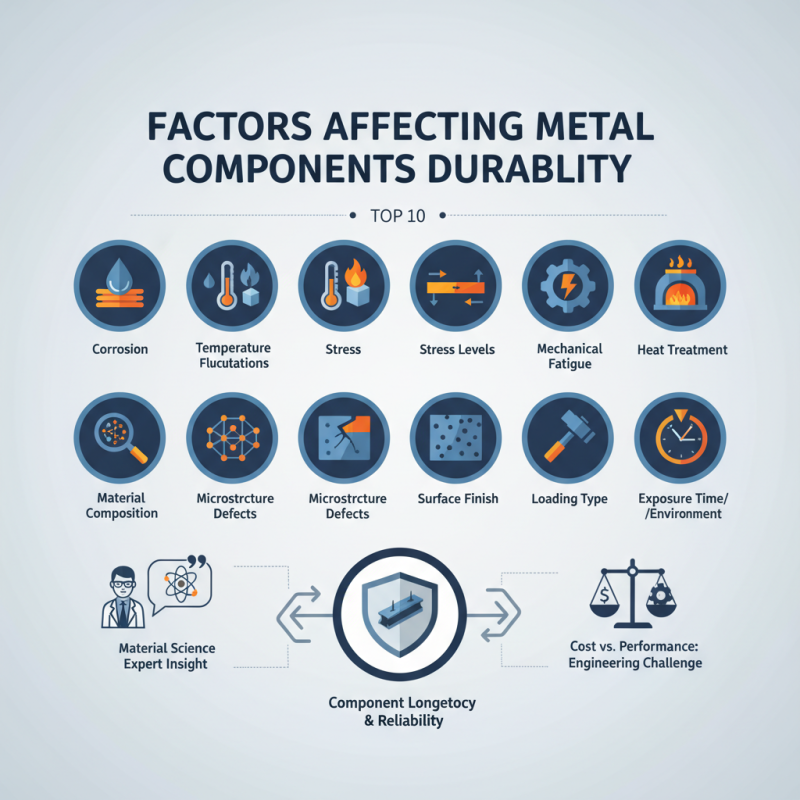
In the realm of engineering, the longevity of metal components remains a critical focus. Understanding what factors affect the durability of metal components can dictate the success of various applications. Dr. Emily Carter, a leading expert in materials science, states, "The environment and the treatment of the metal play crucial roles in its longevity."
Many elements influence durability. Corrosion, temperature fluctuations, and stress levels must all be considered. For instance, exposure to moisture can lead to rust, weakening the metal over time. Additionally, improper heat treatment can compromise structural integrity, leading to premature failure.
This subject poses challenges and invites deeper reflection. Engineers often grapple with balancing cost and performance. The ideal choice may not always be evident. Exploring these factors requires continuous learning and adaptation in practices. Understanding what factors affect the durability of metal components is imperative for enhancing reliability in design and application.
Factors Influencing Wear Resistance in Metal Components
Wear resistance is crucial for the longevity of metal components. Various factors significantly influence this characteristic. Material composition plays a vital role. For instance, alloying elements can enhance hardness and toughness, which are critical for wear resistance. According to a report by the Institute of Materials, components made with high carbon steels exhibit better performance in abrasive environments.
Heat treatment processes also affect wear resistance. Adjusting the temperature and duration can increase the hardness of metal components. A study published by the Journal of Applied Metal Research found that components subjected to quenching and tempering offered 30% greater wear resistance than untreated counterparts. These methodologies can significantly improve product lifespan.
Surface treatments are another important aspect. Techniques such as nitriding or coating can enhance durability. Research indicates that metallurgically treated surfaces reduce friction, leading to lower wear rates. However, costs and process complexities can pose challenges. Industry experts suggest that while advancements are promising, ongoing evaluation is necessary to optimize these treatments for specific applications. Understanding these factors is critical for those involved in manufacturing and maintenance.
The Role of Corrosion Resistance in Metal Durability
Corrosion resistance plays a crucial role in the durability of metal components. Without it, even high-quality metals can suffer damage over time. Factors like moisture and salt can accelerate the corrosion process. For industries relying on metal parts, understanding corrosion is essential.
Tips: Consider applying protective coatings on metal surfaces. Regular maintenance checks can identify early signs of corrosion.
Environmental conditions significantly impact metal durability. Factors such as humidity levels, temperature changes, and exposure to chemicals can heighten corrosion risks. Metals like stainless steel offer better resistance, but they are not immune. Monitoring the conditions in which metal components operate is vital.
Tips: Educate staff about corrosion prevention techniques. Utilize corrosion inhibitors to extend the lifespan of metal components.
Factors Affecting Metal Components Durability
Understanding the factors affecting the durability of metal components is crucial, especially in engineering and manufacturing. Corrosion resistance plays a pivotal role, making up 35% of the total impact on durability, followed by material quality and heat treatment. Other factors also contribute significantly to the longevity of metal parts.
Impact of Temperature Fluctuations on Metal Component Longevity
Temperature fluctuations significantly impact the longevity of metal components. When metal is heated, it expands. Conversely, it contracts as it cools. This constant cycle of expansion and contraction can lead to fatigue in the material. Over time, microcracks develop, and these can compromise the structural integrity.
The severity of temperature changes also matters. In environments with extreme variations, the risk of damage increases. Metals lose strength at elevated temperatures. For instance, steel can become softer and less capable of bearing loads. In contrast, at low temperatures, certain metals become brittle. This brittleness may lead to unexpected failures.
Regular maintenance can mitigate some effects of temperature fluctuations. Inspections are crucial in identifying areas of stress. Implementing protective coatings offers another layer of defense. However, those options are not foolproof. Many components still fail due to unnoticed temperature effects. Understanding these nuances is vital. It emphasizes the need for reliable design practices. Temperature management is essential in prolonging the life of metal components.
How Manufacturing Processes Affect Metal Component Strength
The strength of metal components largely depends on the manufacturing processes used. Different techniques can lead to varying levels of durability and reliability. For instance, welding can sometimes create weak points. These potential flaws can compromise the overall strength of the component.
Heat treatment is a crucial step. It alters the structure of metal at a microscopic level. Proper temperature control is essential to enhance strength. However, inadequate attention can lead to brittleness or warping. Each step in the process needs precision to ensure durability.
Casting methods also play a significant role. Poor casting can introduce defects such as air pockets and inclusions. These imperfections can weaken components. Understanding the implications of each manufacturing process is vital. It requires time and expertise to achieve optimal results in metal component durability.
Top 10 Factors Affecting Metal Components Durability
| Factor |
Description |
Impact on Durability |
| Material Composition |
The type and proportion of metals and alloys used. |
High-quality alloys enhance strength and resistance to wear. |
| Manufacturing Process |
The method used to shape and assemble metal components. |
Processes like forging or casting influence grain structure and strength. |
| Heat Treatment |
Controlled heating and cooling to alter material properties. |
Improves hardness, increases tensile strength and fatigue resistance. |
| Surface Finish |
The treatment of a material's surface to improve aesthetics and durability. |
A smooth surface reduces corrosion and wear. |
| Environmental Conditions |
Exposure to moisture, temperature, and chemical agents. |
Extreme conditions can accelerate oxidation and degradation. |
| Joint Design |
The way components are joined together (welding, bolts). |
Proper design enhances load distribution and reduces stress concentrations. |
| Load Conditions |
Types and magnitude of forces acting on the component. |
Static and dynamic loads affect the lifespan and failure mechanisms. |
| Quality Control |
The processes used to ensure products meet specifications. |
Rigorous testing prevents defects that lead to early failure. |
| Fatigue Resistance |
The ability of a material to withstand cyclic loading. |
Materials designed for high fatigue limits enhance component longevity. |
| Design Specifications |
Engineering requirements and intended use of components. |
Thorough specifications lead to optimal functionality and durability. |
Significance of Alloy Composition in Enhancing Metal Durability
The alloy composition plays a crucial role in the durability of metal components. Different elements can enhance or degrade the intrinsic properties of a base metal. For instance, adding chromium and nickel to steel can significantly improve its corrosion resistance. This is essential for components exposed to harsh environments.
However, the balance is delicate. An excess of certain elements can lead to brittleness, weakening the overall structure. For example, too much carbon in steel can cause it to become hard but fragile. Monitoring these compounds during the manufacturing process is vital.
Understanding the significance of alloy composition is not straightforward. It requires extensive knowledge of metallurgy and materials science. Some engineers may overlook minor elements, resulting in unexpected failures. Experimentation with different compositions can yield useful insights but also demands detailed analysis over time. This ongoing learning process is essential to achieve optimal performance in metal components.
Conclusion
The durability of metal components is crucial in various applications, and several key factors influence this characteristic. First, wear resistance is a vital property that determines how well metals can withstand abrasive forces over time. Meanwhile, corrosion resistance plays a significant role in preventing degradation due to environmental exposure. Additionally, temperature fluctuations can impact component longevity, as metals may expand or contract, leading to stress and wear.
Moreover, the manufacturing processes employed during production directly affect the strength and overall performance of metal parts. Finally, the composition of alloys is essential in enhancing durability, as different elements can impart unique properties to the metal. Understanding what factors affect the durability of metal components is fundamental for optimizing performance and ensuring reliability in their applications.

 ElvisCast Precision