Top 10 Ways to Prevent Corrosion in Metal Piping Systems

Time:2026-10-14 Author:Mason
0%

Corrosion quietly weakens metal piping systems long before a leak becomes visible. Inside a plant, a thin rust layer can grow beneath insulation, supports, or pooled water. Eventually, wall thickness decreases, flow becomes restricted, and an unexpected shutdown may follow. Understanding how to prevent corrosion in metal piping systems requires more than applying paint to exposed surfaces.

Effective prevention begins with field experience and disciplined inspection. Material selection, water chemistry, operating temperature, pressure, and electrical contact between different metals all influence corrosion rates. Carbon steel, stainless steel, copper, and galvanized components do not respond identically. A solution that protects one section may damage another. That detail is often overlooked.

This guide examines ten practical control methods used by maintenance teams, engineers, and corrosion specialists. Protective coatings, corrosion inhibitors, cathodic protection, drainage design, and regular thickness testing each have a specific role. Small details matter. A damaged coating around a flange can expose the entire joint to moisture. Poorly placed pipe supports can trap water for years.

No method is perfect. Even a well-designed system can deteriorate when inspections become irregular or operating conditions change. Reliable protection combines sound engineering, documented maintenance, and timely corrective work. The recommendations ahead are intended to support safer decisions, longer service life, and fewer costly piping failures. Local standards, manufacturer guidance, and qualified professional assessment should still guide final implementation.
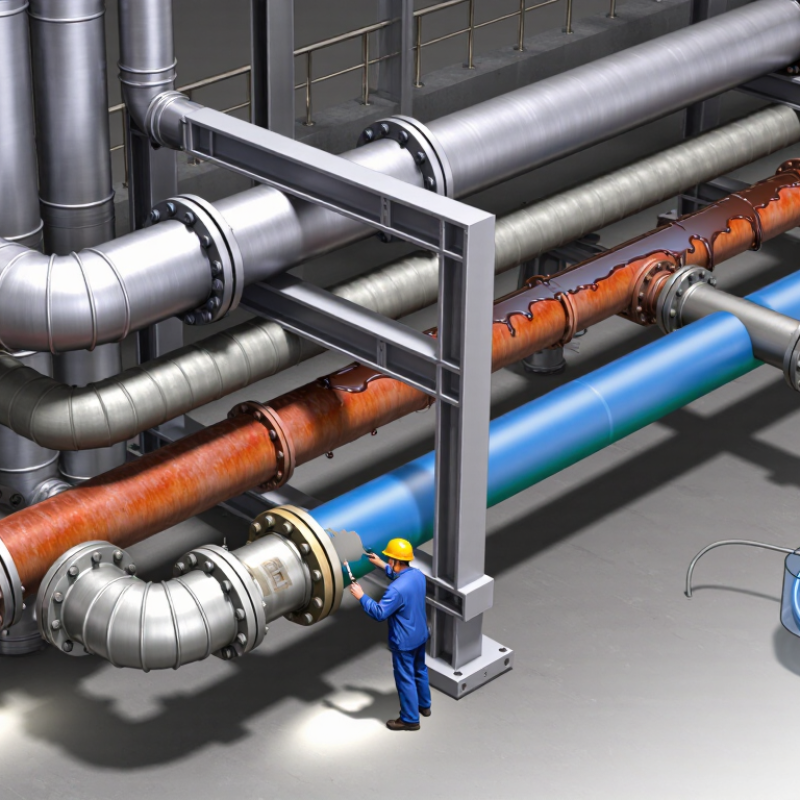
Top 10 Ways to Prevent Corrosion in Metal Piping Systems

Understanding Corrosion Risks in Metal Piping Systems

Corrosion risk in metal piping systems is rarely visible at the beginning. Moisture, oxygen, chlorides, acidic fluids, and stagnant zones can quietly reduce wall thickness. Under insulation, corrosion may remain hidden until a leak appears. The NACE IMPACT study estimated global corrosion costs at about $2.5 trillion annually, equal to 3.4% of global gross domestic product. It also reported that 15–35% of these costs could be reduced through effective corrosion management.

A practical prevention plan starts with ten controls: select compatible alloys, verify water chemistry, limit oxygen entry, remove stagnant branches, control flow velocity, apply suitable coatings, use cathodic protection, install corrosion coupons, inspect welds, and measure wall thickness regularly. Drain low points. Seal insulation carefully. Small gaps matter. Industry guidance, including ISO 12944 coating principles and AMPP inspection practices, supports risk-based maintenance rather than calendar-only repairs. However, coating selection can fail when surface preparation is rushed or operating temperatures change.

Field experience shows that failures often develop where drawings look harmless: dead legs, threaded joints, support clamps, and pipe bottoms. A risk register should record fluid composition, temperature, pressure, age, inspection history, and likely failure consequences. Ultrasonic testing can identify thinning before perforation, but readings need trained technicians and consistent locations. No method is perfect. Teams should review unexpected findings, question old assumptions, and update inspection intervals after every significant process change.

Selecting Corrosion-Resistant Materials and Protective Linings

Top 10 Ways to Prevent Corrosion in Metal Piping Systems

Selecting the right metal and lining is often the strongest corrosion-control decision. The NACE IMPACT study estimated global corrosion costs at 2.5 trillion US dollars annually, equal to about 3.4% of global GDP. Carbon steel may suit dry, neutral service, but chlorides, low pH, and high temperatures can quickly damage it. Stainless steel, duplex alloys, or nickel-based materials may perform better, yet higher cost does not guarantee safety. Galvanic contact, weld zones, and stagnant flow still require review.

Protective linings create a physical barrier between the pipe wall and aggressive fluids. Epoxy systems can protect many chemical-service lines, while rubber or thermoplastic linings may handle stronger abrasion or chemical exposure. Surface preparation remains critical. Oil, rust, or trapped moisture beneath a lining can create blistering within months. Inspectors should verify dry-film thickness, adhesion, holiday detection, and curing conditions. These details are easy to overlook.

Tips: Match the lining to pH, temperature, pressure, and chemical concentration. Check permeation data, not only chemical-resistance charts. Protect elbows and welds first. Maintain drainage and avoid dead legs. Review inspection records annually.

Material selection is never permanent. Operating conditions change, and an apparently suitable lining may age faster than expected. A practical design includes corrosion allowances, removable inspection sections, and monitoring points. The AMPP corrosion-management framework supports risk-based inspection, but field evidence should challenge the original assumptions. Sometimes, the cheapest material becomes the most expensive choice.

Top 10 Ways to Prevent Corrosion in Metal Piping Systems - Selecting Corrosion-Resistant Materials and Protective Linings

No. Prevention Method Material or Lining Selection Primary Corrosion Risk Addressed Best-Fit Service Conditions Key Design and Application Practice Verification and Maintenance
1 Select corrosion-resistant alloys Use stainless steel, duplex stainless steel, nickel alloys, or corrosion-resistant copper alloys when their compatibility with the fluid is confirmed. General corrosion, pitting, crevice corrosion, and erosion-corrosion. Services where fluid chemistry, temperature, chloride level, velocity, and pressure justify the higher material cost. Check chemical compatibility and welding requirements; avoid assuming that every stainless grade is suitable for chloride-containing water. Inspect welds, heat-affected zones, pitting, and wall thickness during scheduled inspections.
2 Apply internal protective linings Use properly selected epoxy, novolac epoxy, polyurethane, rubber, glass-flake, or cement-mortar linings for carbon-steel pipe. Uniform internal corrosion and chemical attack on carbon steel. Water, wastewater, hydrocarbons, acids, alkalis, and abrasive slurries, depending on the lining chemistry and temperature limit. Prepare the steel to the specified cleanliness and surface profile; control coating thickness, curing, and holiday-free continuity. Use visual inspection, dry-film-thickness checks, adhesion testing, and holiday detection where applicable.
3 Use thermoplastic or composite pipe Consider polyethylene, polypropylene, fluoropolymer-lined pipe, or fiber-reinforced polymer when pressure, temperature, and permeation limits are acceptable. Electrochemical corrosion and chemical attack that affect metallic pipe walls. Many corrosive chemical, water, wastewater, and slurry services within the selected material's pressure and temperature range. Account for thermal expansion, support spacing, joining method, UV exposure, permeation, and mechanical impact. Check joints, supports, deformation, brittleness, liner continuity, and chemical exposure history.
4 Apply external coating systems Use a compatible primer and topcoat system such as zinc-rich, epoxy, polyurethane, or other specified protective coatings. Atmospheric corrosion, marine exposure, soil-side corrosion, and moisture ingress. Aboveground piping, buried steel, splash zones, humid environments, and industrial atmospheres. Design for drainage and access; remove contaminants and salts before coating; protect damaged areas and field joints. Inspect for blistering, rust creep, cracking, underfilm corrosion, and coating holidays.
5 Use cathodic protection Install sacrificial anodes or impressed-current systems for electrically continuous buried or submerged steel systems. External corrosion caused by soil or electrolyte exposure. Buried pipelines, submerged piping, tank bottoms, and other structures exposed to an electrolyte. Coordinate the system with external coatings, electrical isolation, current distribution, and nearby metallic structures. Measure structure-to-electrolyte potentials, inspect anodes and rectifiers, and confirm electrical continuity.
6 Control galvanic corrosion Use compatible metals or electrically isolate dissimilar metals with insulating flanges, sleeves, washers, and gaskets. Accelerated attack at connections between dissimilar metals in an electrolyte. Wet systems, seawater, process water, condensate, and outdoor assemblies where different alloys are joined. Minimize unfavorable cathode-to-anode area ratios and prevent conductive bypasses across isolation kits. Test electrical isolation and inspect interfaces for leakage, deposits, and localized attack.
7 Manage water chemistry and inhibitors Use approved corrosion inhibitors, oxygen scavengers, biocides, or pH and alkalinity control where the process permits. Carbon dioxide corrosion, oxygen corrosion, microbiologically influenced corrosion, and scale-related cells. Closed-loop water, boiler feedwater, cooling-water, produced-water, and other chemically managed systems. Base treatment on water analysis and process compatibility; control dosing so it does not create environmental or product-quality problems. Trend pH, conductivity, dissolved oxygen, iron, microbial activity, inhibitor residual, and corrosion-coupon results.
8 Prevent stagnant zones and deposits Use corrosion-resistant materials or linings in dead legs, low points, drains, and areas prone to sediment accumulation. Under-deposit corrosion, differential aeration cells, crevice corrosion, and microbiologically influenced corrosion. Low-flow water systems, slurry lines, intermittent service, and piping with frequent shutdowns. Provide effective drainage, flushing points, cleanable layouts, suitable slope, and minimal dead-leg length. Flush or clean at defined intervals and inspect low points, drains, strainers, and rarely used branches.
9 Control flow velocity and erosion Select erosion-resistant alloys, abrasion-resistant linings, or larger pipe diameters where solids or high velocity are unavoidable. Erosion-corrosion, impingement attack, cavitation, and removal of protective films. Slurries, gas-liquid flow, high-velocity water, elbows, reducers, valves, and pump discharge sections. Avoid abrupt changes in direction and area; use appropriate fittings and keep solids concentration and velocity within design limits. Monitor pressure drop, vibration, flow rate, and wall thickness at elbows and other high-risk locations.
10 Build an inspection and monitoring program Combine suitable materials and linings with corrosion monitoring, non-destructive examination, and risk-based inspection planning. Unexpected internal, external, localized, and mechanical-assisted corrosion. All metal piping systems, especially those carrying toxic, flammable, high-temperature, or environmentally harmful fluids. Establish corrosion circuits, baseline thickness readings, inspection intervals, acceptance criteria, and repair procedures. Use ultrasonic thickness testing, radiography where appropriate, visual inspection, corrosion probes, coupons, and documented trend analysis.

Note: Material, lining, coating, and inhibitor selection should be validated against the actual fluid composition, temperature, pressure, flow regime, contaminants, and applicable design and safety standards.

Controlling Water Chemistry and Internal Operating Conditions

Top 10 Ways to Prevent Corrosion in Metal Piping Systems

Controlling water chemistry begins with measurement, not assumptions. Test pH, conductivity, chloride, sulfate, alkalinity, dissolved oxygen, and temperature at representative points. A single sample near the treatment unit can miss aggressive water downstream. Keep it controlled.

The NACE IMPACT study estimated global corrosion costs at approximately 2.5 trillion dollars annually, equal to 3.4% of global gross domestic product.

Its analysis also found that applying established corrosion-control practices could reduce costs by 15% to 35%. These figures support routine chemistry control, not occasional testing. Maintain pH within the material’s qualified operating range, limit chloride concentration, and reduce oxygen entry through sound seals and closed-system management. Avoid sudden chemical changes. They can destabilize protective films.

Internal operating conditions matter just as much. High velocity can strip protective layers, while low flow allows deposits and microbiologically influenced corrosion to develop in dead legs. Monitor temperature excursions, flow changes, pressure drops, and stagnant branches.

The NACE report “Corrosion Costs and Preventive Strategies in the United States” estimated direct annual corrosion costs at 276 billion dollars in 2002. That older figure still shows the scale of preventable loss. However, chemistry limits should never be copied blindly between systems. Alloy, weld condition, water source, and cleaning history change the risk. A practical control plan may still have blind spots, so review trends with inspection findings and revise limits when evidence disagrees.

Applying Coatings, Cathodic Protection, and Corrosion Inhibitors

Metal piping corrodes when moisture, oxygen, salts, and electrical differences attack exposed surfaces. A prevention plan should begin with accurate site conditions, not assumptions. Inspect welds, elbows, supports, and low points where water commonly remains. Field conditions change. Clean steel thoroughly before coating. Remove mill scale, oil, and loose rust. Select a coating for temperature, pressure, chemical exposure, and immersion conditions. Apply the specified dry-film thickness, then verify it with a calibrated gauge. Small pinholes matter. They can become deep pits beneath an otherwise sound film.

Cathodic protection makes the pipe act as the protected surface in an electrochemical cell. Sacrificial anodes can suit smaller or isolated systems. Impressed-current systems may serve extensive buried networks. Engineers must calculate current demand and check potential readings regularly. Excessive protection can damage coatings or create hydrogen-related problems in susceptible metals. Poorly placed anodes may leave shaded areas unprotected. It is not install-and-forget work. Soil resistivity, coating condition, and electrical continuity should be documented during commissioning and maintenance.

Corrosion inhibitors add another barrier, especially in closed water, steam, or process circuits. Choose dosage according to fluid chemistry, flow rate, temperature, and metallurgy. Monitor concentration, pH, iron levels, and coupon results instead of trusting one test. Inhibitors can deplete quickly after makeup water enters. Overdosing can waste resources and disturb downstream treatment. Combining sound coatings, controlled cathodic protection, and measured inhibitor dosing improves reliability. Still, no method compensates for neglected inspection. Review failures honestly; an incorrect assumption about stagnant water may matter more than an expensive repair.

Inspecting, Monitoring, and Maintaining Piping System Integrity

Corrosion control begins with disciplined inspection, not occasional repairs. Inspectors should map every pipe, elbow, flange, drain, and support. These locations often collect moisture, debris, or chemical residue. Look for blistered coatings, rust staining, pitting, wall thinning, and wet insulation. A small stain can hide serious metal loss.

Use ultrasonic thickness testing at fixed measurement points. Record readings with dates, locations, temperatures, and equipment conditions. Compare results against the original wall thickness and the minimum allowable value. Visual checks should support, not replace, thickness measurements. A clean reading can still mislead when pitting is narrow or uneven. Inspectors should also examine dead legs, low points, welds, and areas beneath pipe clamps.

Monitoring makes maintenance more reliable. Track flow, pressure, temperature, moisture, and chemical concentration within defined limits. Sudden changes may indicate under-deposit corrosion, erosion, or a failed protective system. Test water quality when it influences corrosion rates. Check coatings for cracking and repair damaged areas before exposed steel turns orange. Verify drainage around supports and remove standing water. Cathodic protection systems require documented readings and timely adjustment.

Maintenance records should show what was inspected, who performed it, and what changed. Risk-based inspection intervals are useful, but they should not become rigid habits. Some systems need shorter intervals after process changes or repeated leaks. Field teams should question normal-looking data and investigate inconsistent measurements. Even experienced crews miss hidden corrosion sometimes. That possibility deserves attention during every inspection.

FAQS

How should I choose metal for a corrosive piping system?

Match the material to pH, chlorides, temperature, pressure, and flow conditions. Carbon steel may suit dry, neutral service. Stainless, duplex, or nickel-based alloys may perform better in harsher environments. Higher cost does not guarantee safety.

Why are protective linings important inside metal pipes?

Linings separate the pipe wall from aggressive fluids. Epoxy can suit many chemical services. Rubber or thermoplastic linings may handle stronger abrasion or chemical exposure. Surface preparation matters greatly.

What inspection checks should confirm a lining was applied correctly?

Check dry-film thickness, adhesion, curing conditions, and holiday detection. Remove oil, rust, and trapped moisture before application. A tiny pinhole can become a deep pit.

Which water chemistry measurements are most useful?

Test pH, conductivity, chloride, sulfate, alkalinity, dissolved oxygen, and temperature. Sample several locations, including downstream points. One sample can miss aggressive water.

How do flow conditions affect internal corrosion?

High velocity can strip protective films. Low flow allows deposits and microbial corrosion in dead legs. Monitor flow changes, pressure drops, temperature excursions, and stagnant branches.

Can coatings prevent corrosion without regular inspection?

No. Inspect welds, elbows, supports, low points, and damaged coating areas. Verify coating thickness with a calibrated gauge. Field conditions change.

When is cathodic protection appropriate for piping?

Sacrificial anodes may suit smaller or isolated systems. Impressed-current systems may support larger buried networks. Check current demand, potential readings, soil resistivity, and electrical continuity.

How should corrosion inhibitors be managed?

Set dosage according to fluid chemistry, temperature, flow rate, and metallurgy. Monitor concentration, pH, iron levels, and coupon results. Makeup water can reduce inhibitor concentration quickly.

What design features can reduce corrosion risk?

Include corrosion allowances, drainage, removable inspection sections, and monitoring points. Avoid dead legs and stagnant branches. Protect elbows and welds carefully. Sometimes, the cheaper option costs more later.

How often should a corrosion-control plan be reviewed?

Review inspection records and chemistry trends at least annually. Reassess after changes in temperature, flow, water source, or cleaning history. The original assumptions may be wrong.

Conclusion

Corrosion in metal piping systems can cause leaks, contamination, reduced efficiency, and costly shutdowns, making prevention an essential part of system design and maintenance. This overview explains how to prevent corrosion in metal piping systems by first identifying risks such as moisture, chemical exposure, temperature changes, dissolved gases, and incompatible metals. It also highlights the importance of selecting suitable corrosion-resistant materials, using protective linings, and designing piping layouts that reduce stagnant zones and crevice formation.

Effective protection also depends on controlling water chemistry, flow conditions, pressure, and temperature within safe operating ranges. Additional strategies include applying suitable external coatings, using cathodic protection where appropriate, and adding corrosion inhibitors under controlled conditions. Regular inspection, thickness measurement, leak testing, and corrosion monitoring help detect early damage before it becomes a serious failure. Finally, scheduled cleaning, timely repairs, accurate records, and ongoing maintenance ensure the piping system remains reliable, efficient, and protected throughout its service life.

Mason

Mason

Mason is a seasoned marketing professional with a deep expertise in the company's offerings and a passion for driving brand awareness. With a strong background in digital marketing strategies, he has an innate ability to connect with diverse audiences and effectively communicate product benefits.......